
DBN HEARTBEAT thematic areas
DBN Data Stories

HEARTBEAT data stories.

Move through DBN's strategic sectors and discover the data behind the opportunities, challenges and development impact.

Explore thematic areas
c:\mac\home\desktop\dbn assets 2.0 proposal\dbn-main\dbn-main\views\stories\index.cshtmlsection-kicker"> HEARTBEAT

Thematic areas

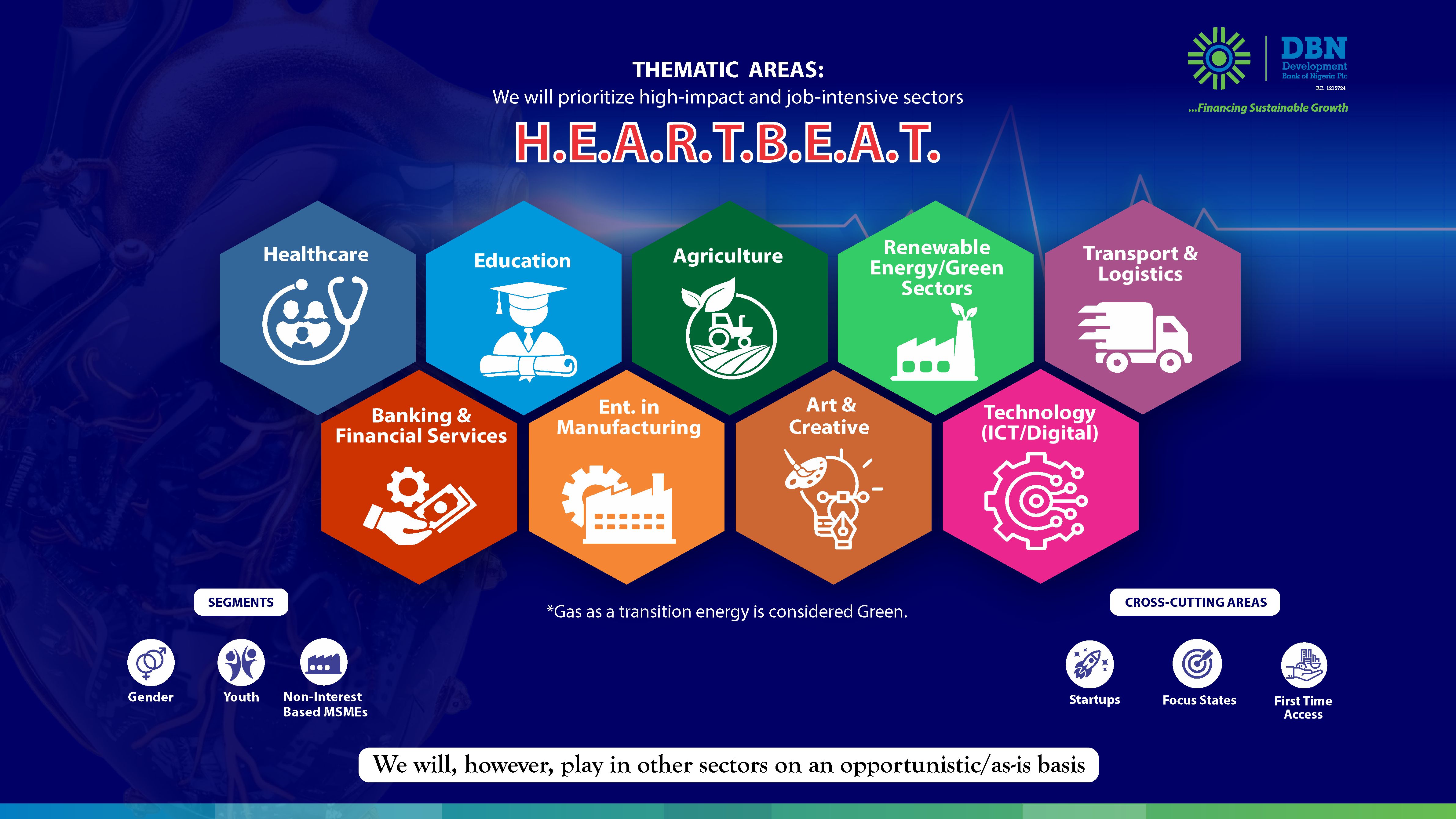
The H.E.A.R.T.B.E.A.T. Sectors are DBN's nine strategic priority sectors that underpin Nigeria's economic and social development. These sectors were identified for their critical role in creating jobs, strengthening human capital, advancing food and energy security, and driving industrial and digital transformation

Healthcare H
Healthcare

Beyond Hospitals: Financing the MSMEs that Power Nigeria’s Health System

Nigeria’s frontline healthcare depends on clinics, pharmacies, laboratories, medical suppliers and health technology firms operating with fragile balance sheets and limited access to patient capital. The result is a health system financed largely at the point of illness: households bear the cost, providers defer investment and access remains constrained. Financing healthcare MSMEs is not a marginal enterprise intervention; it is an investment in the infrastructure of care, skilled

Read data story


Agriculture A
Agriculture

Agriculture’s Missing Capital: Financing the MSMEs that Feed Nigeria

Nigeria cannot solve food insecurity, youth unemployment, and rural poverty while its most important productive sector remains structurally underfinanced relative to its economic weight. The opportunity is not simply to lend more. It is to finance the MSMEs that feed households, move produce, process output, create jobs, and build resilience across the agricultural value chain. Agricultural MSMEs are not peripheral players in this story. They are the operating system of the sector

Read data story
Renewable Energy/Green Sectors R
Renewable Energy/Green Sectors

Powering the Missing Middle: Financing the MSMEs Driving Nigeria’s Green Transition

Nigeria’s green transition will not be delivered by large infrastructure projects alone. It will depend on the MSMEs that install mini-grids, distribute solar systems, finance clean-cooking solutions, maintain equipment and put reliable energy to productive use. These enterprises sit closest to the access gap, yet their capital needs rarely fit conventional lending. Financing them is how energy access becomes enterprise growth, jobs and resilience.

Read data story
Transport & Logistics T
Transport & Logistics

Nigeria’s Mobility Divide: Financing the Operators Who Keep the Economy Moving

Nigeria’s transport economy runs on productive assets that many operators do not own. High acquisition costs, short loan tenors and limited credit histories keep viable drivers, logistics providers and delivery businesses outside formal finance. The result is abundant demand served by weak asset ownership, ageing fleets and high operating costs. Better transport finance must therefore be built around the asset, the operator’s cash flow and the full cost of ownership. Done well, it can convert

Read data story
Banking & Financial Services B
Banking & Financial Services

Beyond Bank Accounts: Turning Financial Access into Productive Credit

Nigeria has brought millions of businesses into the payments system without building an equally effective system for financing their growth. MSMEs generate transactions, receivables and digital records every day, yet formal credit remains too small, costly and poorly structured for much of the productive base. The next phase of financial-sector development must turn information into confidence, confidence into credit and credit into stronger enterprises, jobs and output.

Read data story
Enterprises in Manufacturing E
Enterprises in Manufacturing

Made in Nigeria: Financing the Small Producers Behind Nigeria’s Industrial Future

Nigeria cannot build industrial capability while manufacturers finance long-lived machinery with short-term and high-cost credit. Small producers need working capital for inputs and orders, medium-term finance for equipment and energy systems, and patient capital for expansion. Industrial finance must follow the production cycle. When it does, credit becomes machinery, output, jobs and export capacity rather than another pressure on already-thin cash flows.

Read data story
Art & Creativity A
Art & Creativity

Turning Global Applause into Local Capital: Financing Nigeria’s Creative Enterprises

Nigeria’s creative economy has built global demand without a financing system capable of converting that demand into durable enterprise value. Creative businesses generate value through intellectual property, royalties, licences, distribution agreements and future receivables, yet traditional lending still depends heavily on physical collateral. The priority is therefore not simply more capital. It is finance designed around how creative value is created, contracted and monetised.

Read data story
Technology (ICT/Digital) T
Technology (ICT/Digital)

Beyond Connectivity: Financing the MSMEs Building Nigeria’s Digital Economy

Nigeria’s digital economy is economically significant but structurally shallow. ICT contributes about one-tenth of real GDP, yet its share of private sector credit has declined, internet adoption remains below half of the population, and fixed broadband penetration is negligible. The next phase of digital growth must therefore move beyond mobile subscriptions towards deeper infrastructure, productive digital adoption and finance for the MSMEs building digital services.

Read data story